Everest Base Camp Trek Cost in 2026–2027: A Line-by-Line Budget
Most trekkers spend USD 1,450–2,100 per person on the Everest Base Camp trek once flights, permits, a guide and porter, rooms, meals and tips are added up. We break down every cost for 2026–2027, with fees checked in November 2026 and our own prices by group size.
Aktualisiert 16 Min. Lesezeit
Auf dieser Seite
- How much does the Everest Base Camp trek cost?
- How much are the Everest Base Camp permits?
- How much do Lukla flights cost?
- How much do teahouse rooms and meals cost?
- How much do a guide and porter cost?
- What about insurance, gear and other extras?
- What changes the price of the trek?
- What does a package include, and what is left out?
- Sample budgets for four ways to trek
- What we'd warn a friend about
- How much is our Everest Base Camp trek?
The Everest Base Camp trek costs most people USD 1,450–2,100 per person once flights, permits, a guide, a porter, rooms, meals and tips are added up, not counting international flights, the visa or insurance. Our own 15-day Everest Base Camp Trek is USD 1,480 per person for two or three trekkers, USD 1,395 for four to seven, USD 1,280 for groups of eight or more and USD 1,795 for one, with flights, permits, staff, meals on the trail and Kathmandu hotels included.
The Lukla flights are what make Everest cost about twice as much as Annapurna Base Camp. After that, the bill climbs with altitude: a meal at Gorak Shep can cost two to three times what the same dish costs near the start of the trail, because everything above the airstrip comes up on a porter's back or a yak.
This is how we budget our own Everest trek. Below we break the budget into each line, show the 2026–2027 fees with the date we checked them, and work through four sample budgets, including what our own price covers and what it leaves to you.
- Typical total per person
- USD 1,450–2,100
- Both permits
- NPR 6,000
- Return Lukla flight from Kathmandu
- ~USD 476
- Room, meals and extras per day
- USD 45–80
- Lukla to Lukla on our itinerary
- 12 days
How much does the Everest Base Camp trek cost?
Expect USD 1,450–2,100 per person for a guided teahouse trek of about two weeks, and USD 2,000 or more for a solo private trek. The spread comes from group size, which airport you fly from, how much you spend on extras and how many nights you lose to the weather.
The table shows totals per person for the trek itself, from Kathmandu back to Kathmandu. International flights, the visa and insurance come on top for every style.
Way of trekking | Per person | What drives it |
|---|---|---|
Paying as you go, two sharing a guide and porter | USD 1,450–2,100, plus the guide's flights and Kathmandu hotels | You book flights, lodges and staff yourself and pay every meal in cash |
Our group trip, four to seven | USD 1,395, about USD 1,600–1,710 with extras and tips | Staff and transfers shared four to seven ways |
Our trip for two or three | USD 1,480, about USD 1,720–1,850 with extras and tips | Guide, porter and transfer shared two or three ways |
Our trip for one | USD 1,795, about USD 2,170–2,360 with extras and tips | Your own guide and porter; nobody shares their wages or the transfer |
Helicopter return from the top | Quoted on the day by the operator | Far more than the walking days it saves; insurance pays only for a medical evacuation |
At the Nepal Rastra Bank rate of about NPR 149 to the US dollar in late November 2026, USD 1,480 is roughly NPR 220,500. On the trail you pay in rupees, so check the current rate before you change money.
How we worked out the pay-as-you-go total
Per person, for two trekkers sharing one licensed guide and one porter on our 12-day Lukla-to-Lukla route, at NPR 149 to the dollar:
Permits: NPR 6,000–6,390, about USD 40–43.
Flights: USD 476 return from Kathmandu, or USD 396 from Ramechhap plus USD 150 for your half of the return road transfer. Call it USD 476–550.
Rooms: six nights low down at USD 7–15 and five nights from Dingboche up at USD 15–25, so USD 120–215.
Meals and hot drinks: 12 days at USD 25–45, so USD 300–540.
Water, showers, charging and wifi: 12 days at USD 8–15, so USD 100–180.
Guide: 12 days at USD 25–35, halved, so USD 150–210.
Porter: 11 days at USD 20–25, halved, so USD 110–138.
Tips: USD 138–192 each, using USD 15–20 a day for the guide and USD 8–12 a day for the porter.
Total: about USD 1,430–2,070 per person, which we round to USD 1,450–2,100. Your guide's return flight and your hotel nights in Kathmandu come on top.
How much are the Everest Base Camp permits?
You need two permits costing NPR 3,000 each for most foreign nationals, NPR 6,000 in total or about USD 40. They are the Sagarmatha National Park entry permit, checked at Monjo, and the Khumbu Pasang Lhamu Rural Municipality permit, collected at Lukla. The Khumbu uses the municipality permit instead of a TIMS card.
Permit | Foreign nationals | SAARC nationals | Where |
|---|---|---|---|
Sagarmatha National Park entry | NPR 3,000 (NPR 3,390 where 13% VAT is added), about USD 20–23 | NPR 1,500 | Kathmandu or the park gate at Monjo |
Khumbu Pasang Lhamu Rural Municipality | NPR 3,000, about USD 20 | NPR 2,000 (also Chinese nationals) | Lukla |
TIMS card | Not used in the Khumbu | Not used | None |
The municipality raised its fee from NPR 2,000 to NPR 3,000 for most foreign nationals from the 2024/25 fiscal year. You may see a third local or environmental fee quoted online. We have found no official notice of one, so we leave it out and will add it if one is announced. Our Nepal trekking permits guide covers every region's permits.
How much do Lukla flights cost?
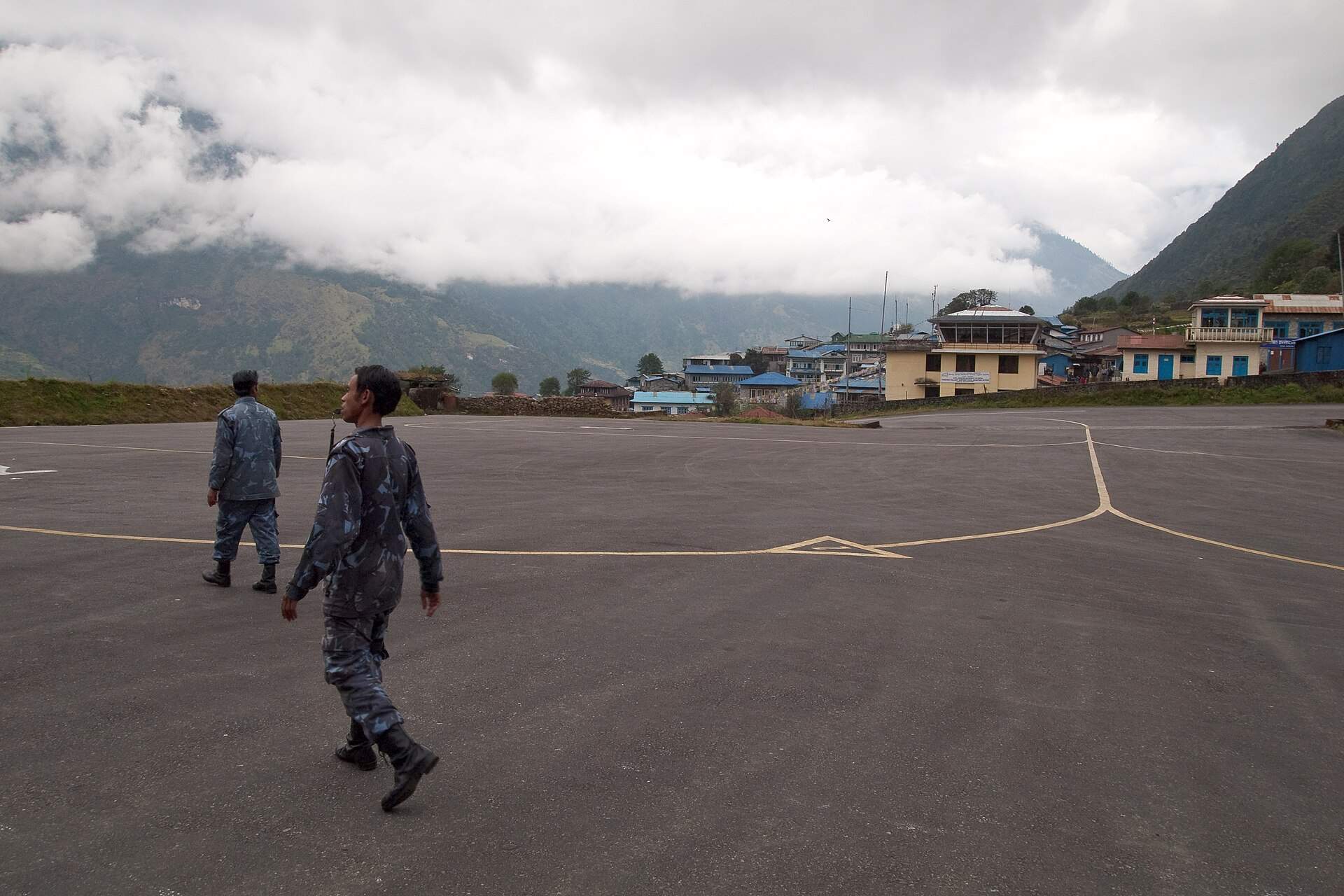
A foreign national pays about USD 238 each way between Kathmandu and Lukla, or about USD 198 between Ramechhap and Lukla, including VAT. Return flights are therefore about USD 400–480 per person, the largest single cost of the trek. Nepali and Indian nationals pay separate, lower fares.
In the main seasons, roughly late March to May and late September to November, scheduled Lukla flights leave from Ramechhap Airport in Manthali, about 132 km and four to five hours' drive from Kathmandu. The cheaper ticket is then offset by the road transfer.
Route | Fare per person, one way | Extra cost | Return per person |
|---|---|---|---|
Kathmandu to Lukla | About USD 238 | None | About USD 476 |
Ramechhap (Manthali) to Lukla | About USD 198 | Private transfer about USD 150 per vehicle each way | About USD 396, plus USD 75–150 each for the transfer if two share |
Shared helicopter, Lukla to Kathmandu | About USD 450–550 per seat | Usually only during long delays | Not a planned cost |
Fuel surcharges on domestic flights rose in April and May 2026, and seats on the busiest autumn mornings are hard to get. Fares move with fuel prices, so we quote the fare at the time of booking. Our page on Lukla flights from Kathmandu and Ramechhap explains the 2 am drive, the airlines and how delays work.
What is the baggage allowance on the Lukla flight?
About 15 kg per person in total: 10 kg checked and 5 kg hand luggage. Excess is charged by the kilo and flown only if there is space. Leave everything you won't need on the trail at your Kathmandu hotel. If you hire your own guide, you also pay their seat at the lower Nepali fare.
How much do teahouse rooms and meals cost?
Budget about USD 45–80 per person a day on the trail for a room, three meals, hot drinks and small extras. Rooms are the cheap part. Food is the biggest daily cost, and prices rise steadily from Lukla to Gorak Shep because every kilo is carried in.
Item | Lukla, Phakding and Namche (2,610–3,440 m) | Dingboche to Gorak Shep (4,410–5,164 m) |
|---|---|---|
Twin room, per person per night | About USD 7–15 | About USD 15–25 |
Breakfast | About USD 5–8 | Top of that range and more at Gorak Shep |
Lunch or dinner | About USD 6–12 | USD 12 and up at Lobuche and Gorak Shep |
Cup of tea | About NPR 100–150 | Up to about NPR 300 |
Boiled or filtered water, per litre | About NPR 150 | About NPR 300–450 |
Hot shower | About NPR 300–500 | About USD 5–15, where available |
Phone or battery charge, per device | About NPR 200, or free | About USD 3–10 |
Wifi card, 24–48 hours | About NPR 1,200–1,500 | About NPR 1,200–1,500 |
Lodges make their money on meals, and many expect you to eat dinner and breakfast where you sleep. Dal bhat with free refills is the best value on any menu; pizza, anything with cheese and imported chocolate are the dearest. Our teahouse trekking guide has more on rooms, toilets and charging.
How much do a guide and porter cost?
A licensed guide costs about USD 25–35 a day and a porter about USD 20–25 a day, normally including their own food and lodging. Two trekkers sharing both pay about USD 23–30 each per day. Over the 12 days from Lukla and back that is roughly USD 260–350 per person.
Since 1 April 2023, Nepal's rules say foreign trekkers on most protected-area routes must walk with a licensed guide. The Khumbu municipality has not enforced that rule, so people still trek the Everest region alone, but every trek we run is led by a licensed guide who checks your oxygen and pulse each evening. A porter usually carries for two trekkers, about 20 kg in total. Porters are often hired in Lukla, which saves a flight. Read whether you need a guide to trek in Nepal for the rules region by region.
How much should I tip on Everest Base Camp?
About USD 15–20 a day for the guide and USD 8–12 a day for each porter, from the group. Over the 12 trail days that comes to USD 276–384 for one guide and one porter, so about USD 138–192 each if two of you share them. Give it at the end, in rupees, one envelope per person. Our page on tipping guides and porters explains how to split it in larger groups.
What about insurance, gear and other extras?
Allow about USD 100–250 for a month of insurance that covers trekking to 6,000 m with helicopter evacuation, USD 50 for a 30-day visa, and whatever you need to buy or rent in gear. These sit outside every trek price, ours included.
Item | Typical cost | Notes |
|---|---|---|
Nepal tourist visa | USD 30 for 15 days, USD 50 for 30 days, USD 125 for 90 days | Our trip is 15 days, so the 30-day visa gives you a margin |
Travel insurance to 6,000 m with helicopter evacuation | About USD 100–250 for a month | Depends on age and home country; required on our trek |
Down jacket or sleeping bag rental | About USD 1–2.50 a day each in Thamel | On our trek both are lent free |
Snacks, soft drinks and beer | Prices double or treble above Namche | Bring snacks from Kathmandu |
Hotel in Kathmandu | Wide range by standard | Included on our trek for the nights in the itinerary |
Check that your policy names trekking (not just hiking) to 6,000 m and helicopter rescue. Without it, an evacuation from the upper Khumbu can cost several thousand dollars. Our travel insurance guide lists what to look for in the wording, and the Department of Immigration publishes the visa fees.
What changes the price of the trek?
Group size changes the price most, then the airport you fly from, then the number of days. Season matters more for availability than for price: our price is the same all year, and what changes in October, November and April is how full the flights and the lodges at Lobuche and Gorak Shep are.
Group size. The guide's wages and the Ramechhap transfer are fixed costs. Shared by four people they cost each person half what they cost two. That is why our price drops from USD 1,795 for one trekker to USD 1,280 each for eight or more.
Kathmandu or Ramechhap. The Ramechhap fare is cheaper, but the transfer brings it back to about the same, and it means a 1–2 am start.
Days. Every day on the trail adds a room, three meals and a day's wages. Cutting an acclimatisation day saves about USD 70–110 each and is the wrong place to save.
Private or shared. A private trip for two costs the same as joining others only if the group is the same size.
Comfort. A private bathroom or single room is available in Lukla, Phakding and Namche at extra cost, but rarely above Dingboche in peak weeks.
Helicopters. Flying out from Gorak Shep or Pheriche saves two or three days of walking but costs far more than the days it saves.
What does a package include, and what is left out?
A full Everest package should include the Lukla flights, the Manthali transfer, both permits, three meals a day on the trail, a licensed guide, a porter and the staff's own flights and insurance. Quotes that leave any of these out look cheaper than the trip will be. This is the list from our own trip page.
Included on our trek | Left for you to pay |
|---|---|
Return Lukla flights, from Kathmandu or Ramechhap | International flights and the Nepal visa |
Private transfer to Ramechhap (Manthali) when flights leave from there | Travel insurance with helicopter evacuation |
Airport transfers and Kathmandu hotel on a twin-share basis with breakfast | Lunch and dinner in Kathmandu |
Teahouse rooms, and breakfast, lunch and dinner with tea or coffee on the trek | Bottled water, soft drinks, alcohol and snacks |
Licensed English-speaking guide; one porter for every two trekkers | Hot showers, charging and wifi where lodges charge |
Staff wages, food, accommodation, insurance and flights | Tips for guide, porters and drivers |
Sagarmatha National Park and Khumbu municipality permits | Extra nights from delays beyond the contingency day |
Down jacket and four-season sleeping bag on loan; duffel bag | Helicopter flights, including to avoid delays |
First-aid kit and pulse oximeter carried by the guide | Excess baggage and personal gear |
To compare two quotes line by line, use our checklist of what a Nepal trekking package should include.
Sample budgets for four ways to trek
Including extras and tips, a trekker on our trip spends about USD 1,600–1,850 if travelling with others and about USD 2,170–2,360 alone; paying as you go costs about USD 1,450–2,100 before the guide's flights and hotels. Add USD 150–300 for the visa and insurance in every case.
Per person | Pay as you go (2 sharing) | Our trip, 4–7 | Our trip, 2–3 | Our trip, solo |
|---|---|---|---|---|
Trek price or booked costs | USD 1,300–1,880 | USD 1,395 | USD 1,480 | USD 1,795 |
Water, showers, charging, wifi, snacks | Included above | USD 100–180 | USD 100–180 | USD 100–180 |
Tips | USD 138–192 | USD 93–132 | USD 138–192 | USD 276–384 for your guide and porter |
Guide's flights and Kathmandu hotels | Extra | Included | Included | Included |
Trek total | About USD 1,450–2,100, plus the guide's flights and hotels | About USD 1,600–1,710 | About USD 1,720–1,850 | About USD 2,170–2,360 |
Visa (30 days) and insurance | USD 150–300 | USD 150–300 | USD 150–300 | USD 150–300 |
For a group of four, the tip line assumes one guide and two porters, shared four ways. The pay-as-you-go column uses the worked sum above; it can come in under our price if you eat simply and the flights run on time, and above it if you lose days to the weather.
What we'd warn a friend about
The figure on a quote is rarely the figure you spend. These are the costs that catch people out on Everest.
Cheap quotes without flights. A package under about USD 1,000 is likely to leave out the Lukla flights, the Manthali transfer or the porter. Ask for the inclusions in writing.
Cash runs short above Namche. The ATMs in Lukla and Namche often run out or reject foreign cards, and there are none higher up. Carry enough rupees from Kathmandu for extras and tips.
Delays you pay for. One contingency day covers most delays. If cloud sits for three or four days, the nights and the helicopter seat are on you, and insurance pays only if your policy covers travel delay.
Gorak Shep prices. By the last two nights a litre of boiled water costs more than a meal in Kathmandu. Fill up on dal bhat and treat your own water.
Single rooms in peak weeks. Lodges at Lobuche and Gorak Shep often put two to a room in October, November and April. A single room may simply not exist.
How much is our Everest Base Camp trek?
Our 15-day trek costs USD 1,795 for one trekker, USD 1,480 each for two or three, USD 1,395 each for four to seven, and USD 1,280 each for eight or more. The price is the same in spring and autumn, and covers everything in the left-hand column of the table above. The Everest Base Camp Trek page has the full day-by-day plan.
We built the itinerary around the cost that matters most at altitude, which is time. It has two acclimatisation days, at Namche Bazaar (3,440 m) and Dingboche (4,410 m), a dawn climb of Kala Patthar (5,545 m), and a contingency day in Kathmandu for Lukla delays. Groups are 1 to 12 people, with one porter for every two trekkers carrying 10 kg each. A porter is included for solo trekkers too. If you would rather carry your own bag, ask us for the price without a porter.
Everest Base Camp Trek at a glance
Reise ansehen- Dauer
- 15 Tage
- Schwierigkeit
- Anspruchsvoll(3 von 5)
- Höchster Punkt
- 5.545 m · Kala Patthar
- Beste Monate
- Mär–Mai, Okt–Nov
- Start und Ziel
- Kathmandu
- Gehzeit
- 3–8 Stunden am Tag
- Gruppe oder privat
- 1–12 Personen
- Unterkunft
- Hotel, Teehaus
- Durchgehend geführt
- Guides sprechen Englisch, Nepali
For the route day by day, the altitude profile and the best months, read our Everest Base Camp trek guide. If the budget is the deciding factor, Everest Base Camp vs Annapurna Base Camp compares the two, and our Nepal trekking cost guide covers every region.
Treks in the Everest region
Frequently asked questions
Is the Everest Base Camp trek expensive?
For a two-week trek with flights, it is good value. Most people spend USD 1,450–2,100 per person on the trek itself. The Lukla flights take a quarter to a third of that, and costs on the trail rise above Dingboche because everything is carried up.
How much does the Everest Base Camp trek cost in Nepali rupees?
At about NPR 149 to the US dollar in late November 2026, USD 1,450–2,100 is roughly NPR 216,000–313,000 per person. Our trip for two at USD 1,480 each is about NPR 220,500 each. The permits are priced in rupees: NPR 6,000 for most foreign nationals.
How much cash should I carry on the Everest Base Camp trek?
On our trip, where meals are included, carry about NPR 2,000–4,000 a day for water, showers, charging, wifi and snacks, plus your tips in rupees. Paying as you go, you need cash for every room and meal too. Withdraw it in Kathmandu, because trail ATMs are unreliable.
Is it cheaper to trek to Everest Base Camp without a guide?
It saves about USD 150–210 per person when two would share a guide, but you take on the bookings, permit runs and altitude decisions yourself. Nepal's 2023 rule requires a licensed guide on most routes, though the Khumbu has not enforced it. We only run guided treks.
Is it cheaper to book the Everest trek in Kathmandu?
Sometimes slightly, but in October, November and April the Lukla seats and the lodges at Lobuche and Gorak Shep are often full. Booking ahead secures flights and lets us prepare permits before you land. Any saving is small next to a lost day.
How much does a helicopter back from Everest Base Camp cost?
A shared seat between Lukla and Kathmandu costs about USD 450–550 when flights are delayed. A helicopter from Gorak Shep or Pheriche costs much more and is priced on the day by the operator. Insurance covers it only for a medical evacuation.
Do children pay for Everest permits?
Children under ten pay neither the Sagarmatha National Park fee nor the Khumbu municipality fee, but they still need the permits issued in their name.
Does the price change between spring and autumn?
Our trip price does not. What changes is availability: seats and rooms are hardest to get in October, early November and April, so book those months earliest.
Why is Everest Base Camp more expensive than Annapurna Base Camp?
Mainly the Lukla flights, about USD 400–480 per person return, which Annapurna treks don't need. Everest also keeps you on the trail longer, and lodge prices in the upper Khumbu are higher than in the Annapurna Sanctuary.