Hidden Lake Trek – 6 dias
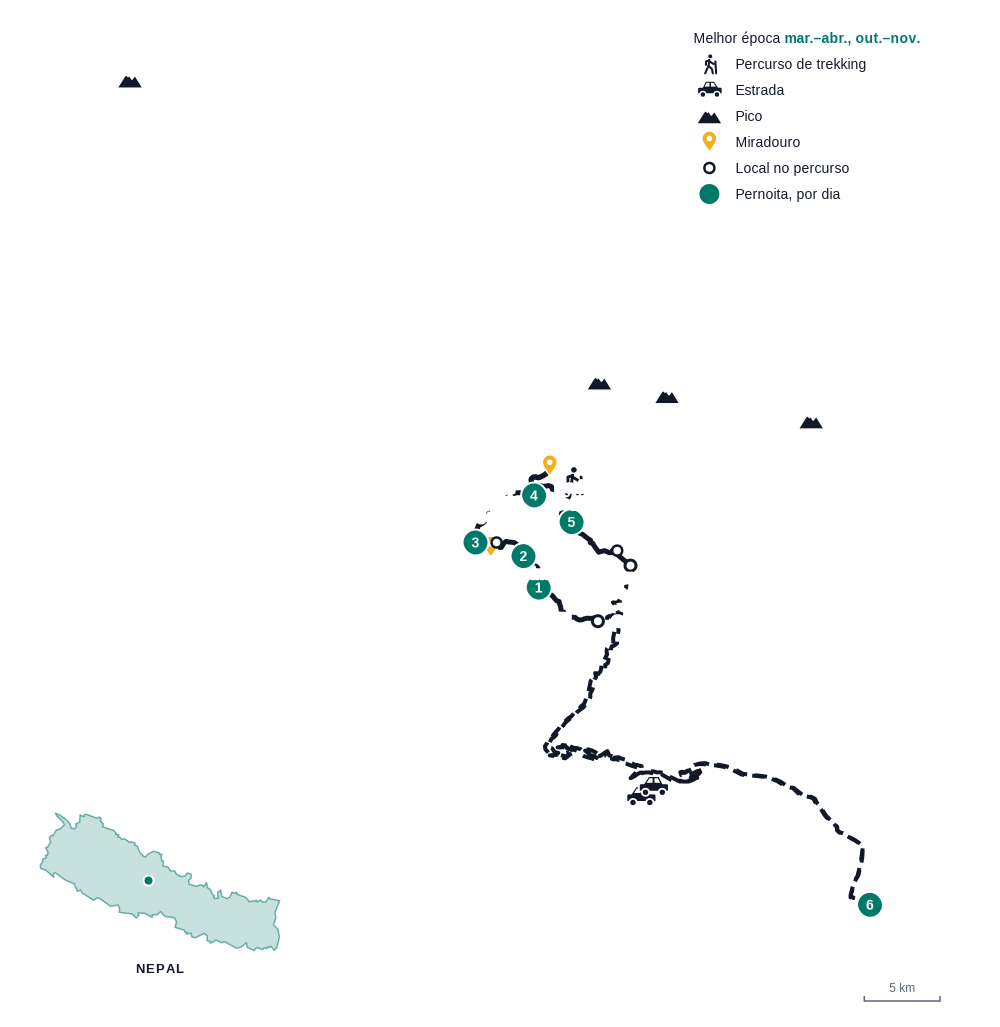
A six-day trek from Pokhara to Hidden Lake (Tridevi Tal), a small lake at about 4,380 m directly below the south face of Annapurna South. The route climbs from Ghandruk through rhododendron forest to Tadapani, Isharu and Dobato, takes in sunset or sunrise at Mulde Viewpoint, then leaves the main trails for Pode Kharka and the lake, before descending through Tiribung and Chhomrong to the road at Jhinu.
- Duração
- 6 dias
- Nível
- Exigente(3 de 5)
- Ponto mais alto
- 4.380 m · Hidden Lake (Tridevi Tal)
- Melhores meses
- mar.–abr., out.–nov.
- Início e fim
- Pokhara
- Caminhada
- 3–8 horas por dia
- Em grupo ou privado
- 1–10 pessoas
- Alojamento
- Casa de chá (teahouse), Lodge
- Totalmente guiado
- Os guias falam Inglês, Nepalês
Visão geral
A six-day trek from Pokhara to Hidden Lake (Tridevi Tal), a small lake at about 4,380 m directly below the south face of Annapurna South. The route climbs from Ghandruk through rhododendron forest to Tadapani, Isharu and Dobato, takes in sunset or sunrise at Mulde Viewpoint, then leaves the main trails for Pode Kharka and the lake, before descending through Tiribung and Chhomrong to the road at Jhinu.
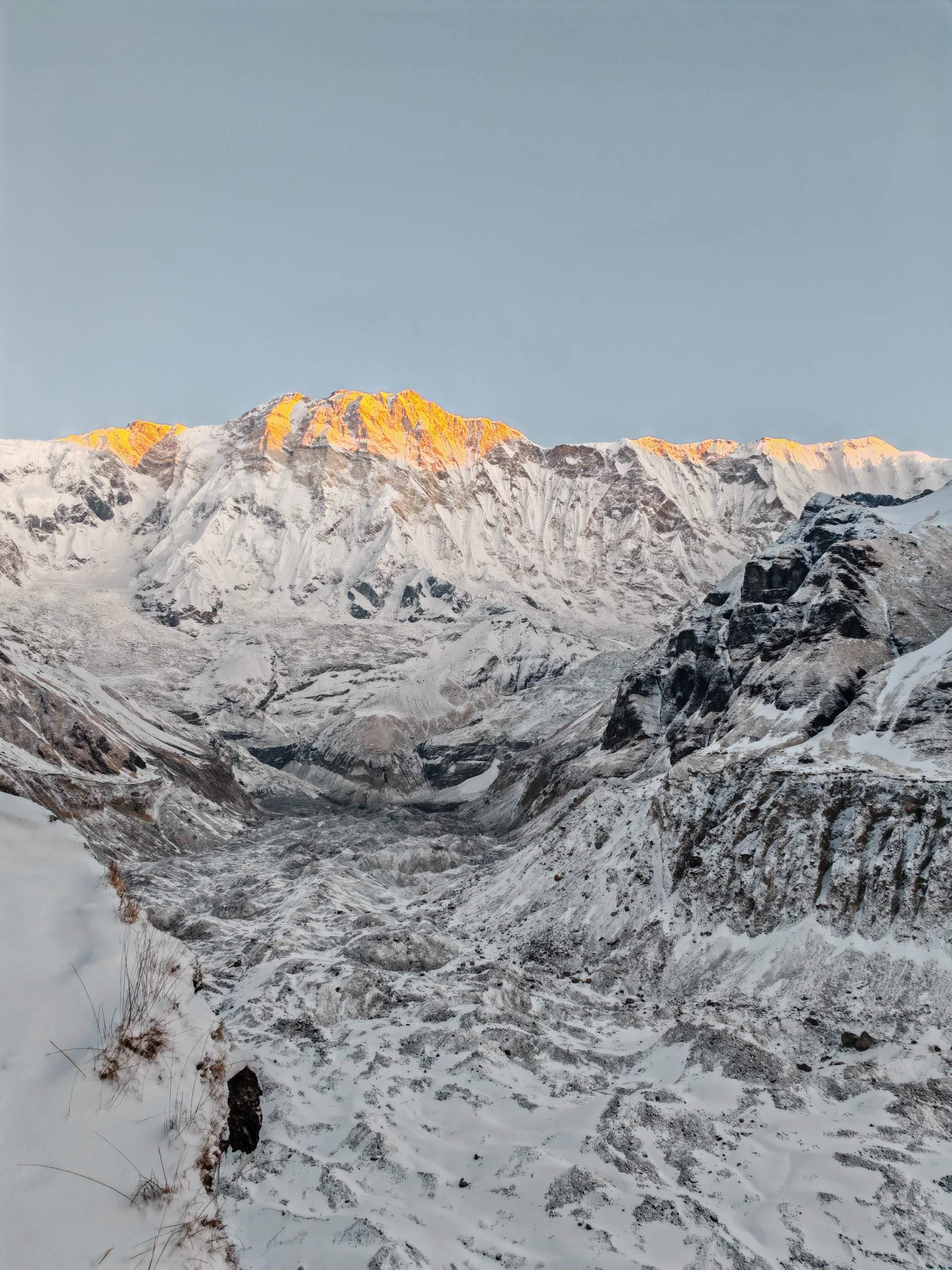
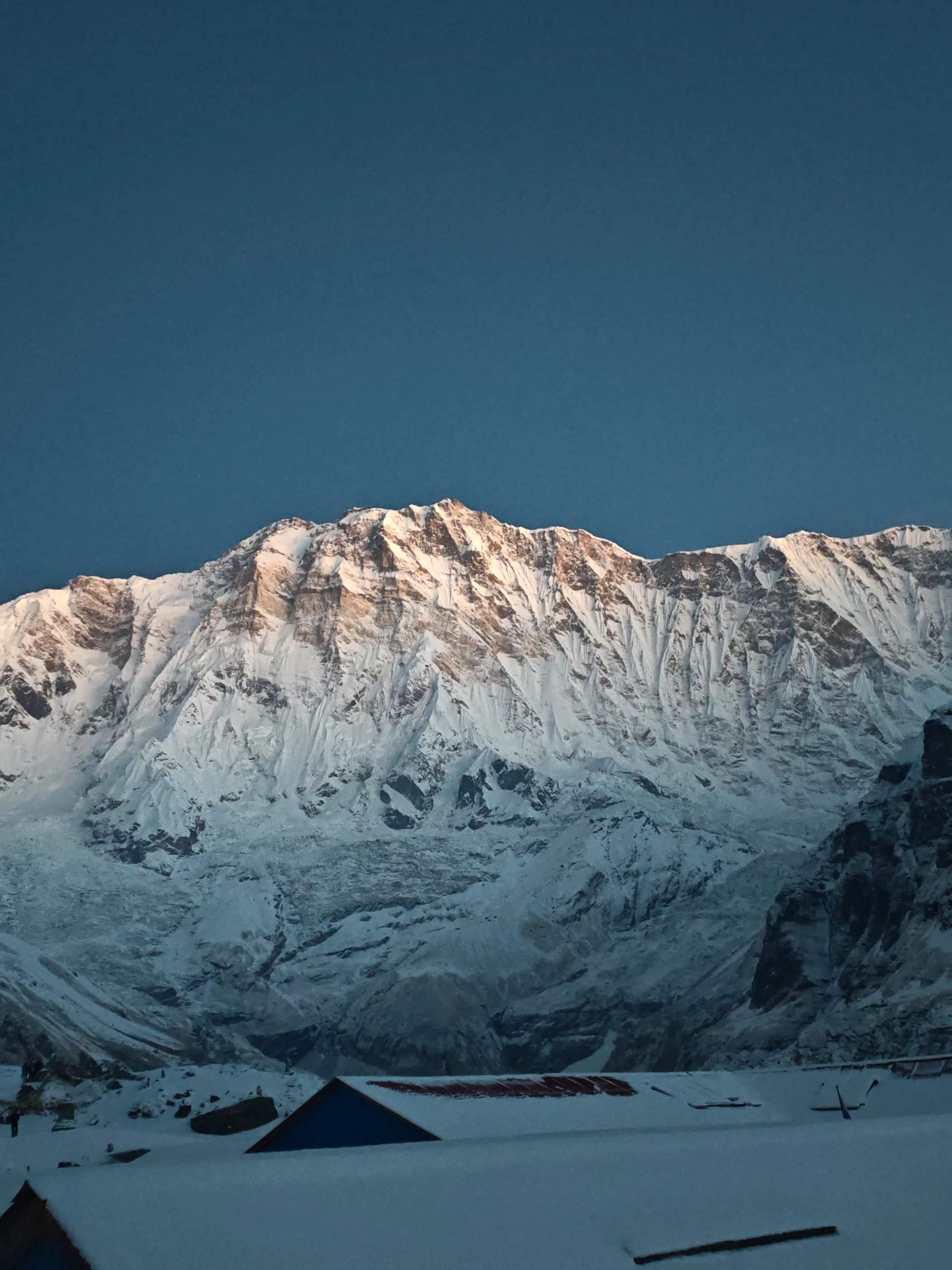
Hidden Lake, called Tridevi Tal by local people, is a small lake at about 4,380 m on the ridge west of the Modi Khola gorge, tucked under the south face of Annapurna South (7,219 m) with Hiunchuli and Machhapuchhre close by. Until recently it was reached only by camping groups. A few simple lodges at Pode Kharka and Tiribung now make it possible as a teahouse trek, and it is still one of the quietest routes this close to Pokhara.
Despite the name, it is not part of the Mardi Himal trek, which runs up the far side of the gorge. The first half follows the forest trail from Ghandruk to Tadapani, Isharu and Dobato, the same way as the Khopra Danda trek, with a climb to Mulde Viewpoint (3,637 m) for a panorama from Dhaulagiri to Machhapuchhre. From Dobato the route turns north-east, up and over open grassland to Pode Kharka at about 4,060 m. Early the next morning you walk to the lake, then descend to Tiribung. On the last day you drop through Chhomrong, the gateway to the Annapurna Sanctuary, to Jhinu Danda and the jeep back to Pokhara.
Most operators run this in five days, which means gaining more than 600 m in a night twice in a row. This version adds a night at Isharu so the climb is spread out, and keeps the day to Dobato short so you can see Mulde at sunset and again at sunrise. The step from Dobato to Pode Kharka is still about 600 m, as there is no lodge in between, so your guide checks everyone's oxygen level before the lake day.
This is a harder trek than Mardi Himal or Poon Hill: you sleep at about 4,060 m, the lake day is seven to eight and a half hours, and the last day descends about 1,900 m. It suits fit walkers who have done a teahouse trek before and want somewhere quieter.
Esta viagem é para mim?
This trek suits fit walkers who have done at least one teahouse trek before, such as Poon Hill, Ghandruk or Mardi Himal. You sleep at about 4,060 m at Pode Kharka, higher than on Mardi Himal or Khopra Danda; the day there from Dobato involves about 800 m of climbing, for a gain in sleeping height of about 600 m. The lake day is seven to eight and a half hours, partly above 4,000 m, and the last day descends about 1,900 m on stone steps through Chhomrong. There is no technical climbing. In the two to three months before you travel, take regular hill walks of five to seven hours with a daypack, add long descents and stair sessions, and do cardio such as running or cycling three times a week. Trekking poles are strongly recommended, and anyone with a heart or lung condition should get medical advice about the altitude.
Perfil de altitude
Roteiro dia a dia
Dia1Drive to Ghandruk, walk to Tadapani
- 2.680 m
- 3–4 h de caminhada
- 6,3 km
- Almoço, Jantar
- Teahouse in Tadapani
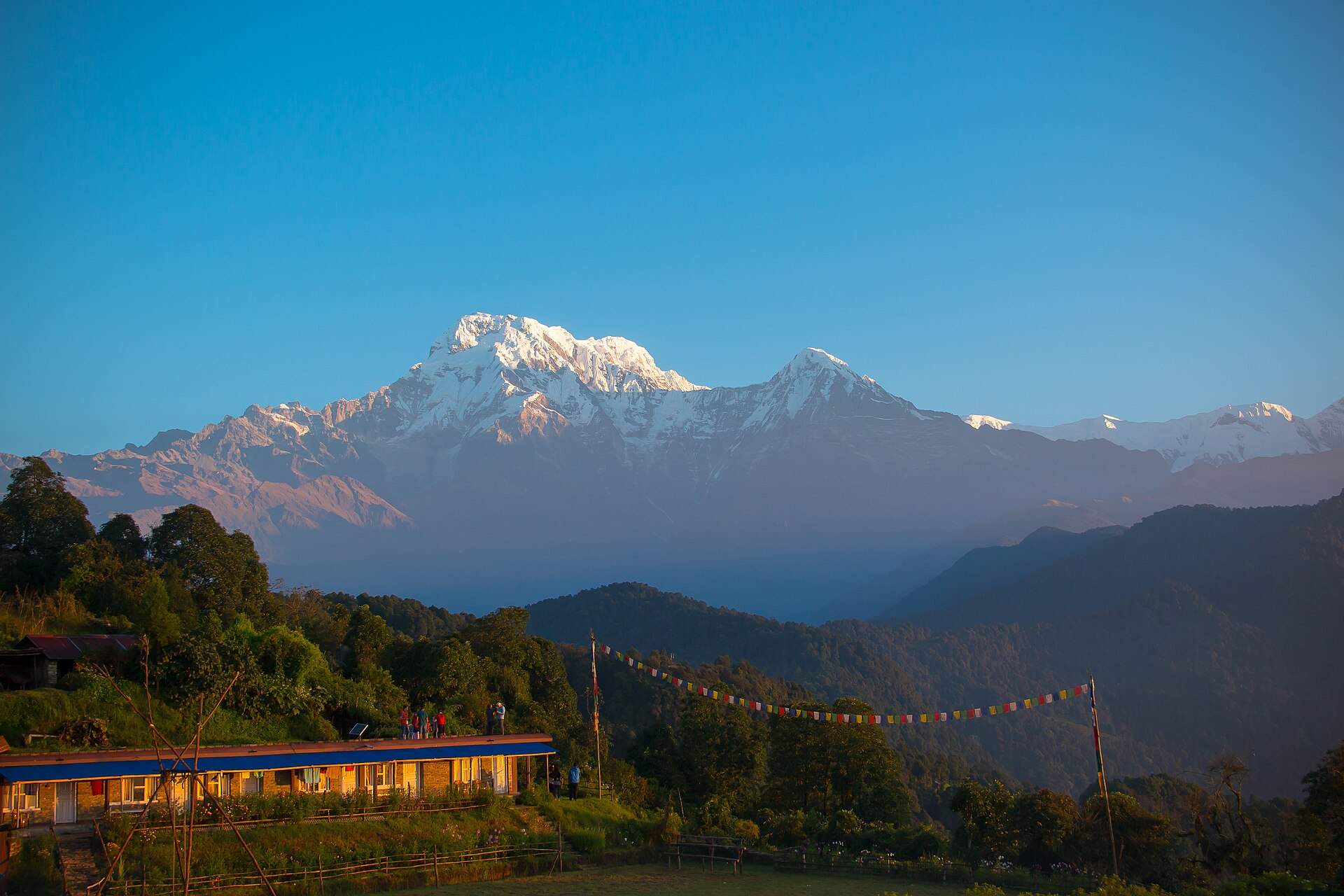
A private jeep leaves Pokhara at about 7 am and drives via Nayapul and Birethanti to Ghandruk, two and a half to three hours. After lunch in this large Gurung village you walk up through terraced fields and then rhododendron and oak forest to Tadapani, a small cluster of lodges on a ridge with Annapurna South and Machhapuchhre close by.
Dia2Tadapani to Isharu
- 3.200 m
- 3–3.5 h de caminhada
- 4,3 km
- Pequeno-almoço, Almoço, Jantar
- Teahouse in Isharu
A short morning's climb through some of the finest rhododendron forest in the Annapurna region, past the tea shops at Meshar, to Isharu at about 3,200 m. Arriving early gives your body time to adjust, and the viewpoint above the lodges is a good place for the afternoon light on Annapurna South.
Dia3Isharu to Dobato, sunset at Mulde Viewpoint
- 3.450 m
- 2.5–3.5 h de caminhada
- 3 km
- Pequeno-almoço, Almoço, Jantar
- Teahouse in Dobato
Another short walk brings you to Dobato by late morning. In the afternoon you climb to Mulde Viewpoint at 3,637 m, where the view runs from Dhaulagiri across Annapurna South and Hiunchuli to Machhapuchhre, and watch the sunset before coming back down to sleep at Dobato.
Dia4Dobato to Pode Kharka
- 4.060 m
- 5–6 h de caminhada
- 5 km
- Pequeno-almoço, Almoço, Jantar
- Lodge at Pode Kharka
If yesterday was cloudy, climb back to Mulde for sunrise first. Then the route leaves the main trails, dropping a little before climbing steadily over open grassland and rocky ground to Pode Kharka, a summer pasture at about 4,060 m with one or two simple lodges. The climb is about 800 m, so go slowly. Your guide checks your oxygen level in the evening.
Dia5Hidden Lake, then down to Tiribung
- 3.430 m
- 7–8.5 h de caminhada
- 12,5 km
- Pequeno-almoço, Almoço, Jantar
- Lodge at Tiribung
You leave at first light and walk about two hours over rocky ground to Hidden Lake at about 4,380 m, beneath the south face of Annapurna South. Mornings give the best chance of a clear view before cloud builds. After time at the shore you return past Pode Kharka and descend east to Tiribung at about 3,430 m. It is a long day of seven to eight and a half hours, with a packed lunch.
Dia6Tiribung to Jhinu, drive to Pokhara
- 822 m
- 4.5–5.5 h de caminhada
- 7,6 km
- Pequeno-almoço, Almoço
- Your Pokhara hotel (not included)
A long, steep descent on stone steps brings you to Chhomrong, the gateway to the Annapurna Sanctuary, and on down to Jhinu Danda, where the hot springs by the river are a short detour if time allows. The jeep meets you at the road end below Jhinu for the drive back to Pokhara, about two and a half to three hours. If the road is damaged and the jeep can only reach Siwai, the night is spent at Jhinu and you drive out next morning.
Datas e disponibilidade
Prefere escolher suas datas? Peça um trekking privativo.
Escolha a sua própria dataO que está incluído
- Private jeep from your Pokhara hotel to Ghandruk, and from the road end below Jhinu Danda back to Pokhara
- A licensed, English-speaking trekking guide for the whole trek, with wages, meals, accommodation and insurance covered
- One porter for every two trekkers (carrying up to about 20 kg in total), with wages, meals, accommodation and insurance covered
- Annapurna Conservation Area Project (ACAP) entry permit, and a TIMS card if one is required for your dates
- Five nights in teahouses and lodges: Tadapani, Isharu, Dobato, Pode Kharka and Tiribung, normally in shared twin rooms
- Breakfast, lunch and dinner from lunch on day one to lunch on day six, with tea or coffee at each meal and a packed lunch on the lake day
- Sleeping bag and down jacket on loan for the trek
- A first aid kit and pulse oximeter carried by your guide
- Trek route map
- International flights and travel between Kathmandu and Pokhara
- Nepal visa fees
- Hotel nights and meals in Pokhara before and after the trek
- Travel insurance covering trekking to 5,000 m and helicopter evacuation
- Drinks other than tea or coffee with meals, snacks and bottled or treated water
- Hot showers, battery charging and wifi where lodges charge for them
- Any small fee collected at Mulde Viewpoint, and entry to the Jhinu hot springs
- Tips for your guide, porter and driver
- Extra nights or costs caused by bad weather, landslides, road closures or leaving the trek early
- Personal trekking equipment and clothing
Licenças incluídas: Área de Conservação do Annapurna (ACAP)
Antes de ir
Altitude on this trek
You sleep at about 2,680 m at Tadapani, 3,200 m at Isharu, 3,450 m at Dobato and 4,060 m at Pode Kharka, then visit the lake at about 4,380 m (published figures range from about 4,270 to 4,380 m) and descend to Tiribung at about 3,430 m. The night at Isharu keeps each step small until Dobato. The step in sleeping height from Dobato to Pode Kharka is about 600 m, a little more than the usual advice of 300 to 500 m a night above 3,000 m, because there is no lodge in between. Your guide checks your oxygen level at Dobato and Pode Kharka, and anyone with symptoms skips the lake and goes straight down to Tiribung. Walk slowly, drink three to four litres a day and avoid alcohol.
Lodges above Dobato
Tadapani, Isharu and Dobato have several teahouses. Above Dobato there are only one or two simple lodges at Pode Kharka and Tiribung, with shared rooms, basic meals and limited power. The operator confirms them before each departure. If a lodge is closed, the trek can still run with a tent and cook for that night, quoted separately, or by a different plan agreed with you before you set off. The lake itself has no visible stream, so carry two litres of water on the lake day.
Permits and the guide rule
The whole route lies inside the Annapurna Conservation Area, so you need an ACAP entry permit: NPR 3,000 for foreign nationals and NPR 1,000 for SAARC nationals, with children under ten free. The operator gets it in Pokhara before you start, using a scan of your passport and a photo. Since 31 March 2023 foreign trekkers on the Annapurna routes that share this trail, including Khopra and Poon Hill to ABC, must walk with a licensed guide booked through a registered agency, and the Nepal Tourism Board lists a TIMS card for them. Checks on the trail vary, and what you need is confirmed when you book. Fees checked November 2026.
Safety and evacuation
Above Dobato the trail is less used, steep and rocky, and easy to lose in cloud, so stay with your guide. Snow and ice can cover the ridge above Dobato from December to early April. Above Ghandruk the road goes only a short way, and from there to Jhinu there is no road; phone signal above Dobato is uncertain, and the nearest health post is at Chhomrong. A serious emergency means a helicopter, which your insurance must cover. The lake is best reached early in the morning, before cloud builds on Annapurna South.
Roads at each end
The jeep to Ghandruk takes about two and a half to three hours via Nayapul and Birethanti. In wet weather or during road work it may stop at Kimche, about 45 minutes' walk below Ghandruk. The return jeep leaves from Samrung, below Jhinu Danda; if that track is damaged the pick-up moves to Siwai, which adds two to three hours of walking. Monsoon floods disrupted the Ghandruk road in 2026: it ran one way from mid-July, was blocked from 13 August and fully reopened on 22 September.
Weather and seasons
October and November give the clearest mornings over the lake, with nights well below freezing at Pode Kharka by late November. March and April are good too, with rhododendrons in flower around Tadapani and Isharu, though snow can linger above Dobato in March and afternoons cloud over. May and early December are possible on request. From mid-December to February snow and cold make the upper section unsafe, and from June to September the monsoon hides the mountains and floods the roads.
Cash and charging
Don't count on an ATM after Pokhara: bring enough Nepali rupees for the trek. Lodges charge a small fee for charging, and power at Pode Kharka and Tiribung is limited, so bring a power bank.
O que levar
Tudo fica a seu cargo, exceto os artigos marcados como “Fornecido” ou “Alugue no local”.
Roupa
Waterproof and windproof jacket
Down jacketFornecido
On loan; essential at Pode Kharka
Fleece mid-layer
Thermal base layers, top and bottom
Trekking shirts and trousers
Warm hat, sun hat, liner gloves and warm gloves
Calçado
Broken-in waterproof boots with ankle support
Rocky ground above Dobato
Sandals or light shoes for the evenings
Trekking socks
Four pairs
Equipamento
Sleeping bag rated to about -10 °CFornecido
On loan
Daypack of 25 to 35 litres
Room for lunch, water and warm layers on the lake day
Trekking polesAlugue no local
Strongly recommended; easy to hire in Pokhara
Head torch
For the early starts to Mulde and the lake
Two one-litre water bottles
Sunglasses with UV protection
Power bank
Limited power above Dobato
Saúde e higiene
Water filter, purification tablets or UV pen
Sun cream (SPF 50) and lip balm
Personal first aid kit, blister plasters and medication
Ask your doctor about altitude medication
Documentos
Passport and two passport photos
Needed for the ACAP permit
Travel insurance details
Must cover helicopter evacuation to 5,000 m
Outros
Nepali rupees in cash
No ATMs on the trail
Snacks such as nuts and energy bars
Perguntas sobre este trekking
Where is Hidden Lake?
On the ridge west of the Modi Khola gorge, at about 4,380 m below the south face of Annapurna South, north-east of Dobato and Mulde Viewpoint. Local people call it Tridevi Tal. It is about 35 km north-west of Pokhara as the crow flies.
Is the Hidden Lake Trek the same as Mardi Himal?
No. Mardi Himal climbs the ridge on the east side of the Modi Khola, towards Machhapuchhre. Hidden Lake is on the west side, below Annapurna South, and shares its trails with the Khopra Danda trek and the Annapurna Base Camp trail instead. It also goes higher: you sleep at about 4,060 m, against about 3,580 m on Mardi Himal.
Why six days when others sell it in five?
Five-day versions gain more than 600 m of sleeping altitude on two nights in a row. Adding a night at Isharu spreads the climb out, gives you an easy afternoon at Mulde Viewpoint, and leaves more energy for the long lake day.
How hard is it?
We grade it challenging. It is not technical, but you sleep at about 4,060 m, walk seven to eight and a half hours on the lake day and descend about 1,900 m on the last day. It suits people who have done a teahouse trek before.
Where do you stay?
In teahouses at Tadapani, Isharu and Dobato, and in simple lodges at Pode Kharka and Tiribung. Rooms are shared and basic above Dobato, with limited power and hot water. Camping is not needed while those lodges are open, and the operator confirms them before each departure.
Do I need a permit and a guide?
You need an ACAP permit (NPR 3,000 for foreign nationals, NPR 1,000 for SAARC nationals), which is included. The trek's trails overlap the Khopra and Poon Hill to ABC routes, which the Nepal Tourism Board lists as needing a licensed guide; one is included.
When is the best time to go?
October and November for clear mornings over the lake, and March and April for rhododendrons in the forest below Dobato. Winter brings snow above Dobato, and the monsoon hides the mountains and closes roads, so neither is recommended.
Can I see Annapurna I from Hidden Lake?
Not really. The lake sits right under Annapurna South, which blocks the view of Annapurna I behind it. What you see is the south face of Annapurna South and Hiunchuli close up, and Machhapuchhre across the gorge.