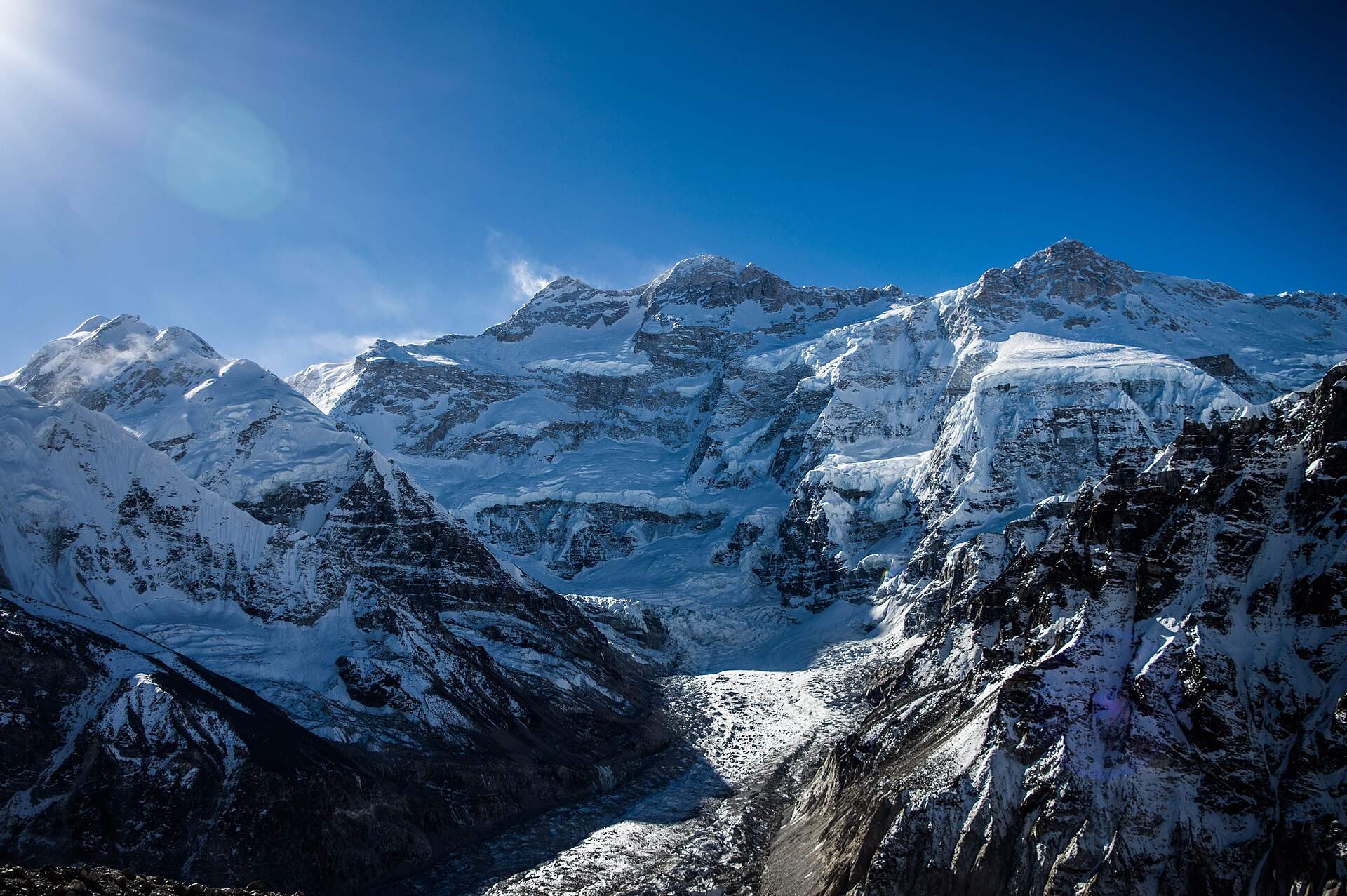
Kanchenjunga
1 trip
Kanchenjunga, the world's third-highest mountain, stands on Nepal's far-eastern border with Sikkim, in Taplejung district. The Nepali side is protected as the Kanchenjunga Conservation Area, and the upper valleys are a restricted area. It is one of the most remote teahouse treks in the country: lodges are simple, villages are far apart and you meet very few other trekkers, even in the main seasons.
Our Kanchenjunga trek
Kanchenjunga Base Camp Trek (20 days, 14 of them walking, top point 5,143 m at Pangpema) visits both base camps. You walk up the Ghunsa valley to Pangpema, the north base camp, then cross the Sele La passes to the south side and Oktang before walking out to Yamphudin. It suits experienced hikers who are comfortable with long days on rough trail several days in a row: most days are five to seven hours, the pass crossing above 4,400 m takes eight to nine hours, and the return hike to Pangpema takes seven to eight. It is not a good choice for a first trek in Nepal.
Permits in 2026
You need two permits. The Kanchenjunga restricted area permit for Taplejung costs USD 20 per person per week for the first four weeks, then USD 25 per week. The Kanchenjunga Conservation Area entry permit costs NPR 2,000 for foreign nationals and NPR 500 for SAARC nationals. The restricted area permit is issued by the Department of Immigration only through a registered trekking agency, for trekkers walking with a licensed guide. Since 22 March 2026 it can be issued to a single trekker, though the guide and agency are still required and one guide can take at most seven trekkers. A TIMS card is not needed with a restricted area permit. The operator arranges both permits in Kathmandu.
Getting there
Kanchenjunga is a long way from Kathmandu. The trek flies to Bhadrapur in the eastern lowlands, then spends most of a day driving to Taplejung and another half-day on a rough jeep road to Sekathum, where the walking starts. At the end you drive from Yamphudin back to Bhadrapur for the flight to Kathmandu. Hill roads can be blocked by landslides early and late in the season, so plan a spare day before your international flight.
Seasons, altitude and difficulty
The trek runs from March to May and in October and November. Autumn usually brings the clearest mountain views; spring is warmer in the lower valleys. Winter snow makes the Sele La crossing difficult, and the monsoon brings cloud and road closures. This is a strenuous trek, graded for fitness and experience as much as altitude. It reaches 5,143 m at Pangpema, so acclimatisation matters and your insurance must cover helicopter evacuation at that height.
For how restricted area permits work across Nepal, read our guide to Nepal trekking permits.