Short Annapurna Base Camp Trek – 7 days
The Short Annapurna Base Camp Trek takes you from Pokhara to Annapurna Base Camp (4,130 m) and back in seven days, with a private jeep both ways and a licensed guide and porter included (one porter for every two trekkers). The jeep drops you at Samrung below Jhinu Danda, and the trail climbs through Chhomrong, Dovan and Deurali into the Annapurna Sanctuary. Unlike most short itineraries, we sleep at Machhapuchhre Base Camp (3,700 m), so the climb from Deurali to base camp is split over two nights instead of one 930 m jump. You see the evening and the sunrise at base camp, descend to Bamboo, then walk out through Chhomrong to the jeep on day seven. There is no spare day, so from December to February snow can stop the group before ABC. Want Poon Hill too? Take the 10-day trek.
- Length
- 7 days
- Grade
- Moderate(2 of 5)
- Highest point
- 4,130 m · Annapurna Base Camp
- Best months
- Mar–May, Oct–Nov
- Starts and ends
- Pokhara
- Walking
- 2–7 hours a day
- Group or private
- 1–12 people
- Stay
- Teahouse
- Fully guided
- Guides speak English, Nepali
Overview
The Short Annapurna Base Camp Trek takes you from Pokhara to Annapurna Base Camp (4,130 m) and back in seven days, with a private jeep both ways and a licensed guide and porter included (one porter for every two trekkers). The jeep drops you at Samrung below Jhinu Danda, and the trail climbs through Chhomrong, Dovan and Deurali into the Annapurna Sanctuary. Unlike most short itineraries, we sleep at Machhapuchhre Base Camp (3,700 m), so the climb from Deurali to base camp is split over two nights instead of one 930 m jump. You see the evening and the sunrise at base camp, descend to Bamboo, then walk out through Chhomrong to the jeep on day seven. There is no spare day, so from December to February snow can stop the group before ABC. Want Poon Hill too? Take the 10-day trek.
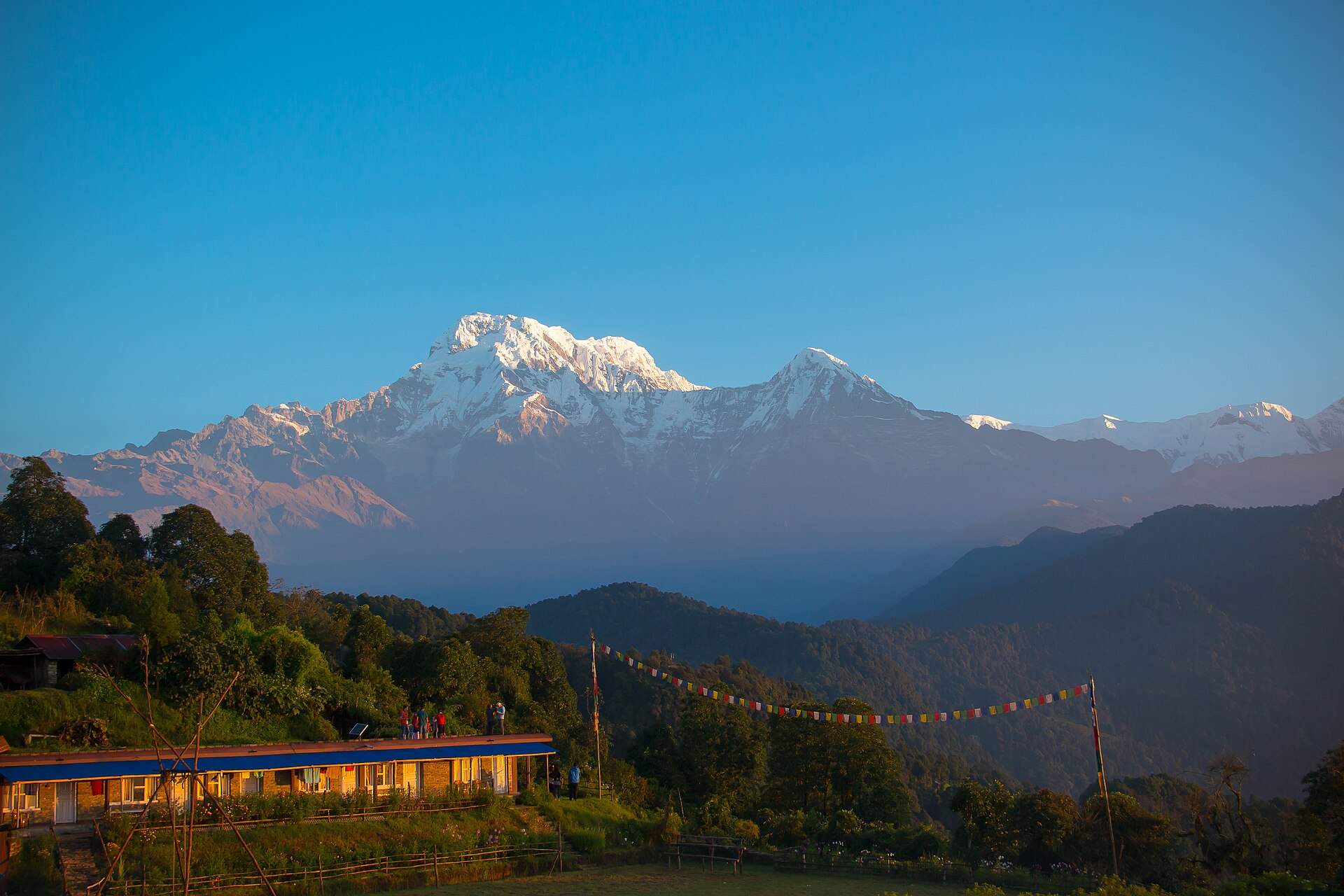
This is the quickest sensible way to reach Annapurna Base Camp from Pokhara. A private jeep takes you up the Modi Khola valley to the road end at Samrung, below Jhinu Danda, and the trail climbs straight to Chhomrong and into the gorge. From there it follows the river through bamboo and rhododendron forest to Dovan and Deurali, then out into the Annapurna Sanctuary, a glacial basin ringed by Annapurna I, Annapurna South, Hiunchuli, Gangapurna and Machhapuchhre. Want Poon Hill too? Take the 10-day trek.
Most five- and six-day versions go from Deurali or Himalaya to base camp in a single day. We sleep at Machhapuchhre Base Camp (3,700 m) instead, so the last climb is split into two short days of 500 m and 430 m, and you have an afternoon and a sunrise at Annapurna Base Camp (4,130 m). The short days through the avalanche-prone upper gorge also let the group cross in the morning.
On the way down we stay at Bamboo, then walk back through Chhomrong and Jhinu Danda to the jeep on day seven. The trail is non-technical, but there are a great many stone steps, especially between Jhinu Danda and Chhomrong. Teahouses are simple, warm and friendly, with menus cooked to order; rooms become more basic and colder above Bamboo. There is no spare day, so from December to February snow can stop the group before base camp.
Choose your ABC trek
- Short Annapurna Base Camp Trek (this trip): 7 days. Route: Samrung, Chhomrong, Dovan, Deurali, Machhapuchhre Base Camp, Annapurna Base Camp, Bamboo. Poon Hill: no. Jeep: both ways, to and from Samrung. Altitude profile: a night at MBC, so Deurali to MBC is +500 m and MBC to ABC +430 m. Price for 2–3: US$590 each.
- Annapurna Base Camp Trek via Poon Hill: 10 days. Route: Ulleri, Ghorepani, Poon Hill, Tadapani, Chhomrong, Bamboo, Deurali, Annapurna Base Camp, Bamboo, Jhinu Danda. Poon Hill: yes. Jeep: out to Nayapul, back from Siwai. Altitude profile: Deurali to ABC in one day, +930 m. Price for 2–3: US$760 each.
- Annapurna Sanctuary Trek via Landruk & Australian Camp: 12 days. Route: Jhinu Danda, Sinuwa, Dovan, Deurali, Annapurna Base Camp, Bamboo, Jhinu Danda, Landruk, Australian Camp, with two Pokhara hotel nights. Poon Hill: no. Jeep: out to Siwai, back from Kande. Altitude profile: Deurali to ABC in one day, +930 m. Price for 2–3: US$840 each.
Cost and what's included
Price per person by group size:
- 1 trekker: US$790
- 2–3 trekkers: US$590 each
- 4–7 trekkers: US$550 each
- 8 or more trekkers: US$505 each
The price includes a licensed guide, one porter for every two trekkers, six nights in teahouses with breakfast, lunch and dinner, a down jacket and sleeping bag on loan, and a private jeep from your Pokhara hotel to the road end and back.
Permits and fees:
- ACAP entry permit: NPR 3,000 for foreign nationals, NPR 1,000 for SAARC nationals, free for children under ten. Included; we arrange it in Pokhara.
- TIMS card: NPR 2,000 (NPR 1,000 for SAARC nationals), as listed by the Nepal Tourism Board. NTB lists a TIMS card for this route; checks on the trail vary, and we confirm what's needed when you book.
Not included:
- International flights and travel between Kathmandu and Pokhara
- Nepal visa fees
- Hotel nights and meals in Pokhara before and after the trek
- Travel insurance covering trekking and helicopter rescue to at least 4,500 m
- Drinks other than tea or coffee with meals, snacks and bottled or treated water
- Hot showers, battery charging and wifi where lodges charge for them
- Tips for your guide and porter
- Extra nights or costs caused by leaving early, bad weather or landslides on the road
Plan this trek
Is it right for me?
This trek suits fit walkers who have not been to altitude before. Most days are five to seven hours on uneven trail with thousands of stone steps, especially around Chhomrong, and the first and last days include long staircases between Jhinu Danda and Chhomrong. The highest night is at 4,130 m. Start training eight to twelve weeks before departure with weekly hill walks of five to six hours carrying a light daypack, stair or step sessions to prepare your legs for the climbs and long descents, and two or three cardio sessions a week such as running, cycling or swimming. Leg strength work such as squats and lunges protects your knees. If you have a heart or lung condition, talk to your doctor before booking.
Route map
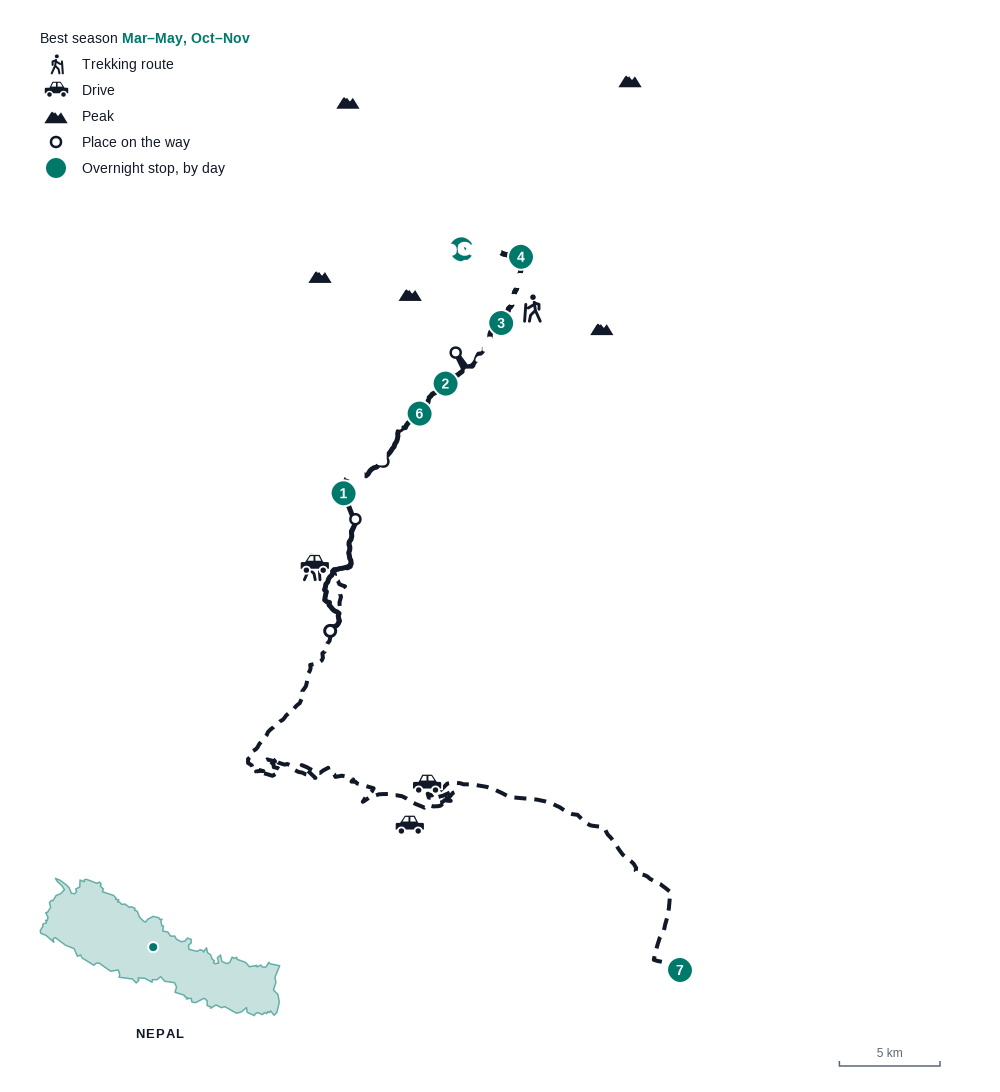
Places: Jhinu Danda · Chhomrong · Sinuwa · Dovan · Himalaya · Deurali · Machhapuchhre Base Camp · Annapurna Base Camp · Annapurna I · Annapurna South · Hiunchuli · Machhapuchhre · Gangapurna
Altitude profile
Day by day
Day1Jeep to Samrung and trek to Chhomrong
- Chhomrong
- 2,170 m
- 2.5–3.5 h walking
- Breakfast, Lunch, Dinner
- Teahouse in Chhomrong
We leave Pokhara early by private jeep and follow the road up the Modi Khola valley past Siwai to the jeep point at Samrung, below Jhinu Danda, about three hours in all. From the road end the trail climbs to Jhinu Danda and then up a long stone staircase to Chhomrong, the largest Gurung village in the valley. Annapurna South and Hiunchuli stand straight up the valley from the lodge terraces. After monsoon damage or heavy rain the jeep may have to stop at Siwai, which adds two to three hours of walking.
Day2Chhomrong to Dovan via Sinuwa and Bamboo
- Dovan
- 2,600 m
- 6–7 h walking
- Breakfast, Lunch, Dinner
- Teahouse in Dovan
Hundreds of stone steps lead down to the suspension bridge over the Chhomrong Khola and up again to Sinuwa. The trail then contours through oak and rhododendron forest to Kuldhigar and drops into the bamboo groves around Bamboo. From here we follow the Modi Khola gorge upstream to the small lodge settlement of Dovan, where the forest is cool and damp and langur monkeys are often seen in the trees.
Day3Dovan to Deurali via Himalaya and Hinku Cave
- Deurali
- 3,200 m
- 3–4 h walking
- Breakfast, Lunch, Dinner
- Teahouse in Deurali
We start early so that the group crosses the upper gorge in the morning. The forest thins as we climb to Himalaya, then the trail passes the rock overhang at Hinku Cave and enters the narrow gorge to Deurali. Above Hinku the trail crosses several avalanche paths, so your guide checks conditions with the lodges and keeps the group moving through these sections. It is a short day, so there is time to rest and drink plenty on arrival.
Day4Deurali to Machhapuchhre Base Camp
- Machhapuchhre Base Camp
- 3,700 m
- 2–3 h walking
- Breakfast, Lunch, Dinner
- Teahouse at Machhapuchhre Base Camp
A short morning walk follows the Modi Khola past Bagar and out of the gorge into the Annapurna Sanctuary. The valley opens at Machhapuchhre Base Camp, beneath the fluted west face of Machhapuchhre. The afternoon is for resting so your body can adjust before the last climb. Sleeping here splits the 930 m climb from Deurali to Annapurna Base Camp into two shorter stages.
Day5Machhapuchhre Base Camp to Annapurna Base Camp
- Annapurna Base Camp
- 4,130 m
- 1.5–2 h walking
- Breakfast, Lunch, Dinner
- Teahouse at Annapurna Base Camp
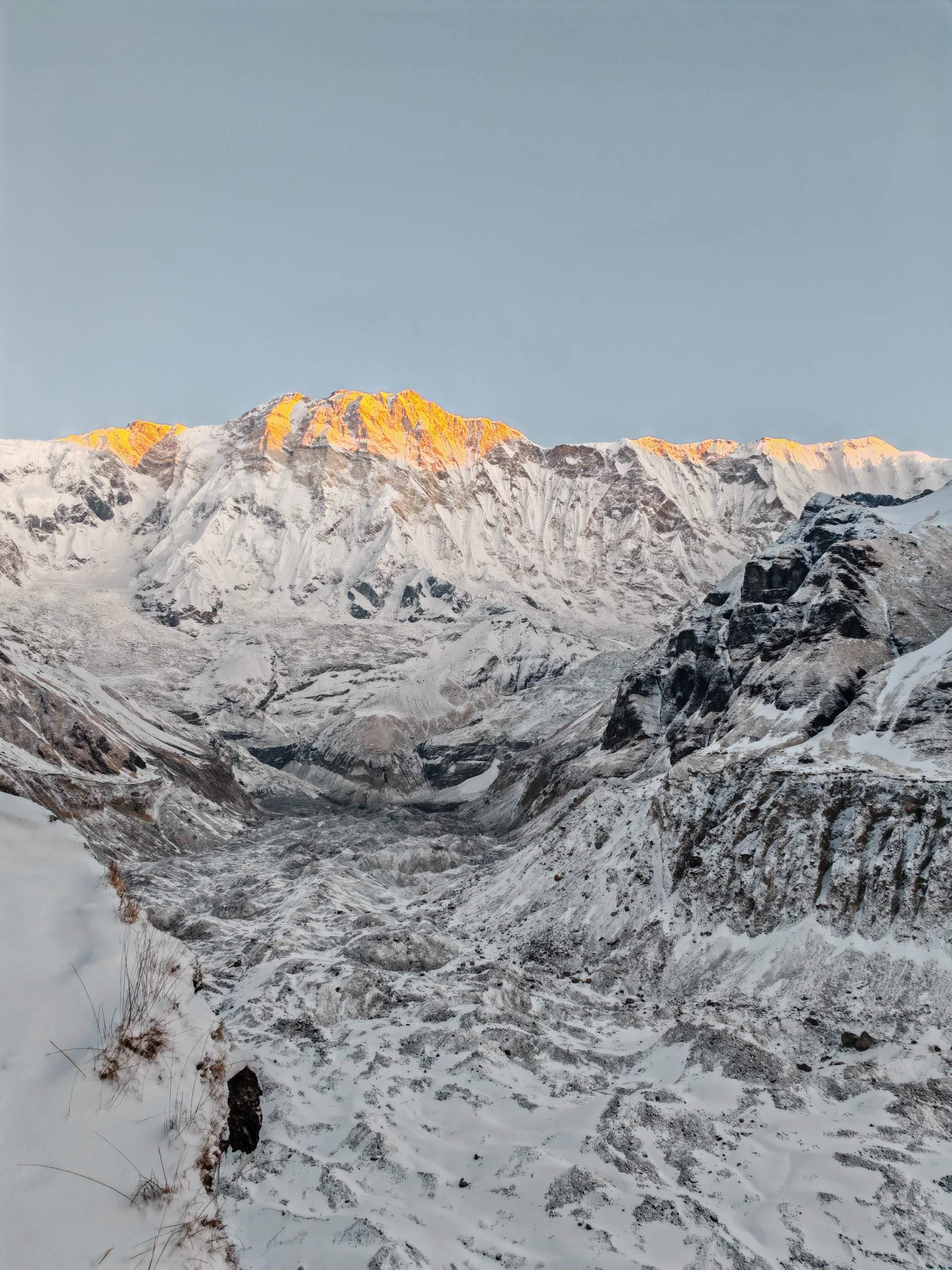
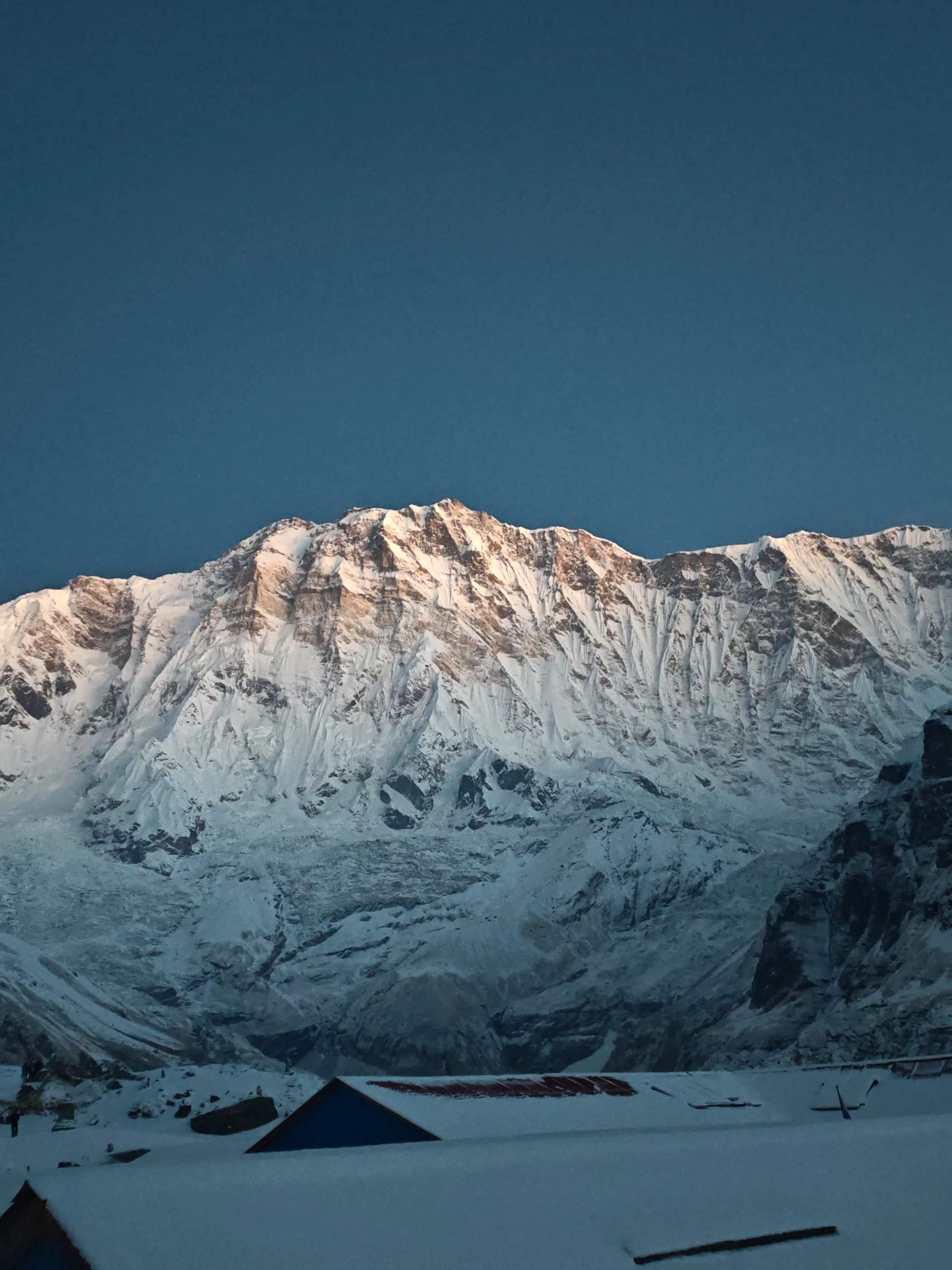
The last climb crosses grassy moraine and takes about two hours, so there is no need to rush. Annapurna Base Camp sits at 4,130 m, ringed by Annapurna I, Annapurna South, Hiunchuli, Gangapurna and Machhapuchhre. The afternoon is free to rest and, if the sky is clear, watch the evening light on the south face of Annapurna I. Walk slowly and drink plenty; this is the highest night of the trek.
Day6Sunrise at Annapurna Base Camp, descend to Bamboo
- Bamboo
- 2,310 m
- 6–7 h walking
- Breakfast, Lunch, Dinner
- Teahouse in Bamboo
Get up before dawn to watch the first light reach the summit of Annapurna I and work its way down the south face. After breakfast we retrace our steps past Machhapuchhre Base Camp, Deurali, Himalaya and Dovan to Bamboo. It is a long day, mostly downhill, and losing height quickly helps you sleep well.
Day7Bamboo to Jhinu Danda and jeep to Pokhara
- Pokhara
- 822 m
- 6–7 h walking
- Breakfast, Lunch
- Your Pokhara hotel (not included)
We climb back to Kuldhigar and Sinuwa, cross the Chhomrong Khola and make the last climb of the trek up the steps to Chhomrong. From there it is downhill to Jhinu Danda and on to the jeep point at Samrung, where a private jeep drives you back to your Pokhara hotel, about three hours. The Jhinu hot springs, about 20 minutes below the village, are an optional stop if time allows. If the jeep cannot reach Samrung, we walk on to Siwai, which adds two to three hours.
Upcoming dates
Next departure Mon, Mar 1, 2027
From US$790 per person
153 dates through November 2027
March 2027
Starts Mon, Mar 1 and ends Sun, Mar 7, 2027
7 days
AvailableUS$790per personGroups from US$505 pp
Starts Tue, Mar 2 and ends Mon, Mar 8, 2027
7 days
AvailableUS$790per personGroups from US$505 pp
Starts Wed, Mar 3 and ends Tue, Mar 9, 2027
7 days
AvailableUS$790per personGroups from US$505 pp
Starts Thu, Mar 4 and ends Wed, Mar 10, 2027
7 days
AvailableUS$790per personGroups from US$505 pp
Starts Fri, Mar 5 and ends Thu, Mar 11, 2027
7 days
AvailableUS$790per personGroups from US$505 pp
Starts Sat, Mar 6 and ends Fri, Mar 12, 2027
7 days
AvailableUS$790per personGroups from US$505 pp
Starts Sun, Mar 7 and ends Sat, Mar 13, 2027
7 days
AvailableUS$790per personGroups from US$505 pp
Starts Mon, Mar 8 and ends Sun, Mar 14, 2027
7 days
AvailableUS$790per personGroups from US$505 pp
Prefer your own dates? Ask for a private trip.
Choose your own dateWhat's included
- A licensed, English-speaking trekking guide for the whole trek, with wages, meals, accommodation and insurance covered
- One porter for every two trekkers (carrying up to about 20 kg in total), with wages, meals, accommodation and insurance covered
- Annapurna Conservation Area Project (ACAP) entry permit
- Teahouse accommodation on the trek for six nights, normally in twin rooms with shared bathrooms at the higher lodges
- Breakfast, lunch and dinner every day on the trek, with tea or coffee at each meal
- Private jeep from your Pokhara hotel to the Samrung road end and back (or Siwai when the road is damaged)
- Down jacket and sleeping bag on loan for the trek, returned at the end
- A first aid kit carried by your guide and a pulse oximeter for daily checks
- Trek route map
- International flights and travel between Kathmandu and Pokhara
- Nepal visa fees
- Hotel nights and meals in Pokhara before and after the trek
- Travel insurance, which must cover trekking and helicopter rescue
- Drinks other than tea or coffee with meals, snacks and bottled or treated water
- Hot showers, battery charging and wifi where lodges charge for them
- Tips for your guide and porter
- Personal trekking equipment and clothing
- Extra nights or costs caused by leaving the trek early, bad weather or landslides on the road
Permits included: Annapurna Conservation Area (ACAP)
Know before you go
Altitude and acclimatisation
You sleep at Deurali (3,200 m), Machhapuchhre Base Camp (3,700 m) and Annapurna Base Camp (4,130 m). Sleeping at Machhapuchhre Base Camp splits the climb from Deurali into two stages of 500 m and 430 m, where our longer ABC treks go from Deurali to base camp (930 m) in one day. Mild headaches and poor sleep are normal; vomiting, confusion, severe breathlessness at rest or loss of balance mean you must descend. Your guide checks you every evening with a pulse oximeter, and descent is quick on this route. Your insurance must cover helicopter evacuation to at least 4,500 m.
Avalanche risk in the upper gorge
Between Himalaya and Machhapuchhre Base Camp the trail runs below slopes that release avalanches after heavy snow, mainly from December to April, and Hinku Cave to Deurali is the most exposed part. In January 2020 an avalanche near Deurali swept away trekkers and guides. Your guide checks conditions with the lodges and the ACAP office before entering this section, keeps the group moving through the marked zones without stopping, waits at a lower lodge after fresh snow and turns back if base camp cannot be reached safely. Days three and four are short so the group can cross in the morning.
Permits and the guide rule
The whole route lies inside the Annapurna Conservation Area, so every trekker needs an Annapurna Conservation Area Project (ACAP) entry permit. The fee is NPR 3,000 for foreign nationals and NPR 1,000 for SAARC nationals; children under ten do not need one. The permit is included and we arrange it in Pokhara before you start, so we need a copy of your passport and a passport photo. NTB lists a TIMS card for this route; checks on the trail vary, and we confirm what's needed when you book. Under the Nepal Tourism Board's 2023 rules, foreign trekkers on this route must walk with a licensed guide arranged through a registered agency; this trek includes one.
Getting to Pokhara
The trek starts and ends in Pokhara. You can reach Pokhara from Kathmandu by a 25-minute domestic flight or by tourist bus (six to eight hours). Plan to arrive the day before the trek, as we leave early on day one, and allow a spare day before any international flight home from Kathmandu in case weather or the road delays the drive back.
Cash, charging and wifi
There are no ATMs on the trail once you leave the road, so draw Nepali rupees in Pokhara for drinks, snacks, hot showers, battery charging, wifi and tips. Prices rise the higher you go because everything is carried up by porters or mules. Most teahouses charge a small fee for charging phones and cameras, and wifi is paid and patchy above Sinuwa. Bring a power bank.
Drinking water
Do not drink untreated tap or stream water. Many villages have refill stations selling treated water, and lodges will fill your bottle with boiled water for a small charge. Bring a filter, purification tablets or a UV pen and two one-litre bottles. Refilling instead of buying bottled water keeps plastic out of the Sanctuary.
Weather, seasons and winter
October and November are the clearest months, with cold nights at base camp. March to May is warmer, with rhododendrons in flower in the forest, but afternoon cloud is common. This trek has no spare day: from December to February snow can close the gorge above Himalaya, and if the guide holds the group for avalanche risk the trek may turn back before Annapurna Base Camp. After the monsoon, landslide repairs can also stop the jeep at Siwai, which adds two to three hours of walking on day one and day seven. We do not run this trek in the monsoon months of June to September.
What to pack
Everything is yours to bring, except items marked “Provided” or “Rent locally”.
Clothing
Base layers: two moisture-wicking tops and one pair of thermal leggings
Fleece or light insulated jacket
Down jacketProvided
On loan from the operator for the trek
Waterproof jacket and overtrousers
Showers are common in spring and the trail can be wet into early October
Two pairs of trekking trousers and a pair of shorts
Warm hat, sun hat and buff
Liner gloves and insulated gloves
Trekking socks (four pairs) and underwear
Footwear
Broken-in waterproof trekking boots with ankle support
The stone staircases are hard on new boots
Sandals or light shoes for the evenings
Gear
Daypack of 25 to 35 litres with rain cover
Your porter carries the main bag
Duffel bag for the porter, kept to about 10 kg per trekker
Sleeping bagProvided
On loan from the operator; a liner adds warmth and hygiene
Trekking polesRent locally
Easy to hire in Pokhara; they save your knees on the descents
Head torch with spare batteries
Needed for the pre-dawn walks
Two one-litre water bottles
Water filter, purification tablets or UV pen
Power bank and charging cables
Sunglasses with UV protection
Health and toiletries
Altitude medicine such as acetazolamide, after advice from your doctor
Sunscreen (SPF 50) and lip balm with SPF
Personal medicines, blister plasters and rehydration salts
Hand sanitiser, quick-dry towel and toiletries
Documents
Passport, with a photocopy and two passport photos
Travel insurance policy details
Your guide keeps a copy with the emergency contacts
Other
Nepali rupees in cash for the trail
No ATMs once you leave the road
Snacks such as energy bars or nuts
Questions about this trip
How many days do I need for Annapurna Base Camp?
Seven days from Pokhara is enough if you use a jeep both ways, as this trek does: six nights on the trail, including one at Machhapuchhre Base Camp before base camp. Five- and six-day versions exist, but they usually go from Deurali or Himalaya to base camp in one day, a much bigger jump in height. If you want Poon Hill as well, allow ten days.
How hard is the short ABC trek?
It is a moderate trek with no technical sections. The challenge is the stone steps around Chhomrong and five to seven hours on foot on most days, with the last climb to 4,130 m. The first and last days are the longest climbs, between Jhinu Danda and Chhomrong. If you can walk all day on hilly ground and repeat it the next day, and you train for two or three months, you should be fine.
Is it suitable for beginners?
Yes, for fit beginners. You need no previous trekking or altitude experience, and your guide sets a steady pace and checks you every evening. Because there is no spare day, it suits people who are comfortable walking six or seven hours and are happy to turn back if the weather or altitude makes it necessary.
How much does the short Annapurna Base Camp trek cost?
US$790 per person for one trekker, US$590 each for two or three, US$550 each for four to seven, and US$505 each for eight or more. That includes a guide, one porter for every two trekkers, the ACAP permit, teahouses, three meals a day and a private jeep both ways. Pokhara hotels, insurance, tips and drinks are extra.
Which permits do I need, and do I need a guide?
You need an ACAP entry permit (NPR 3,000 for foreign nationals), which is included and arranged in Pokhara. NTB lists a TIMS card for this route; checks on the trail vary, and we confirm what's needed when you book. Under the Nepal Tourism Board's 2023 rules, foreign trekkers on this route must walk with a licensed guide through a registered agency; this trek includes one.
What is the best month for this trek?
October and November for the clearest views, then March to May for warmer days and rhododendrons in flower. December to February is possible but risky on a seven-day trek: there is no spare day, and snow can close the gorge above Himalaya and stop the group before base camp. We do not run it in the June to September monsoon.
Does the trek start and finish in Pokhara?
Yes. We pick you up from your Pokhara hotel early on day one and drop you back there in the evening of day seven. The jeep normally reaches Samrung, below Jhinu Danda, in about three hours; if the road is damaged it may stop at Siwai, which adds walking time. Pokhara hotel nights are not included, but we are happy to book one for you.
Want Poon Hill too?
Take our <a href="/trips/annapurna-base-camp-trek">10-day Annapurna Base Camp Trek</a>, which starts at Nayapul and climbs to Ghorepani for sunrise on Poon Hill before crossing to Chhomrong and the Sanctuary. This short trek skips Poon Hill to fit base camp into a week.
Can I do the Short Annapurna Base Camp Trek on my own?
Yes. You can book it as a private trek for one with a licensed guide, who has been required on this route under the permit rules since 31 March 2023 (see <a href="/blog/do-you-need-a-guide-to-trek-in-nepal">do you need a guide</a>). One person pays US$790; two or three pay US$590 each, four to seven US$550 each and eight or more US$505 each, with the private jeep to Samrung and back included. With no spare day, your guide's morning call on weather and altitude decides whether you reach base camp, and you sleep at Machhapuchhre Base Camp first to split the climb. More on <a href="/solo-trekking-in-nepal">solo trekking in Nepal</a>.